
St. Johns County Address Eras
No single roll lists every person who occupied a St. Johns County parcel. Current property data establishes the parcel and title holder. Recorded instruments carry ownership backward. Directories and census schedules supply the household evidence that deeds cannot. Maps and permits date changes to the building itself. The right starting source therefore depends on the period and on whether the question concerns title, a named adult, or the structure.
| Record trail | Verified span | Access point | Useful evidence |
|---|---|---|---|
| Official Records | Interface reaches 1775; series completeness is unconfirmed | Clerk Landmark search, terminal, or request | Parties, dates, legal text, consideration, book/page or instrument |
| Archival court and probate | Clerk, 1821 to about the 1990s; Society, 1821 to early 1950s | Clerk terminals and St. Augustine Historical Society | Estates, heirs, disputes, and filed addresses |
| St. Augustine directories | Verified volumes for 1880 and 1904 | Digitized copies and local history collections | Named adults, work, and house or boarding clues |
| Census schedules | Public federal schedules through 1950 | NARA and library databases | Household members and relationships at the census date |
| Sanborn maps | St. Augustine, 1884-1946; Hastings, 1921 and 1930 | Library of Congress and local collections | Footprint, construction, use, and old street labels |
| Property and permit records | Current roll and historical downloads; permit start unstated | Property Appraiser and Building Department | Title lead, physical work, applicants, inspections, and occupancy certificate |
Begin a recent trail with the current parcel. For the late nineteenth or early twentieth century, establish the old location through a deed, plat, or map before searching names. The verified directory editions are useful points, not proof of a complete run. Ask library or Society staff for the target year rather than assuming an unlisted volume exists. Earlier title questions may reach Spanish land-grant material, while household questions still need a source that actually recorded occupants.
Fix the St. Johns County Parcel
The St. Johns County Property Appraiser Search supplies the current parcel ID, site address, owner mailing address, legal description, land use, sale history, and building facts. Keep both addresses. A tax mailing address may belong to an absentee owner, agent, or post-office box; it does not identify a resident at the site. A homestead entry supports a primary-residence theory but is not final proof of who lived there.
Old house research depends on stable keys. Street numbers and labels can change, and no authoritative countywide renumbering date was found. When modern and historic addresses do not line up, bridge the gap with the legal description, subdivision plat, parcel shape, and a historic map. Never invent a renumbering year. This careful match prevents a chain from drifting to a nearby lot with a similar address.
Reverse St. Johns County Deeds
The Landmark Official Records Search accepts party name, document or case number, book/page, consideration, parcel ID, record date, instrument number, and legal description. An index entry points to an instrument; it is not the instrument itself. Read the deed image when available, since signatures, return address, legal exhibit, witnesses, and other details may resolve a match.
- Pull the present parcel ID, legal description, owner, site address, mailing address, and sale reference from the Property Appraiser.
- Find that owner's purchase in Landmark by parcel, legal text, party, instrument, or book/page. Save the grantor, grantee, date, consideration, and recording reference.
- Search the seller as an earlier grantee. Repeat with middle initials and spelling variants while confirming the same legal description.
- At an uncertain online boundary, use the Clerk's public terminal or send a narrow request instead of treating a blank screen as the end of the chain.
- Add occupants from directories and census schedules only after title and geography are stable.
- Grantor and grantee
- The grantor transfers an interest; the grantee receives it.
- Chain of title
- The linked series of transfers for the same property.
- Legal description
- The lot, block, subdivision, metes-and-bounds, or other land wording that can outlast a street number.
- Instrument
- A recorded document, such as a deed, mortgage, release, or lien.
Cross the St. Johns Records Gap
The Landmark interface offers an old-date shortcut reaching 1775, but the research did not establish that every Official Records series is complete online from that date. Contact the Clerk Recording Division at 904-819-3600 or Recording@stjohnsclerk.com with spelling variants, parcel or legal description, document type, and date range. Ask whether inspection, an ordinary scan, or a certified copy fits the need.
Public terminals and written requests can reach material unavailable remotely. The Clerk's archival court records span 1821 to about the 1990s; the St. Augustine Historical Society has court and probate holdings from 1821 into the early 1950s. A focused Chapter 119 request can ask for electronic copies of a named series tied to an address, parcel, and date range, excluding exempt information. Request an estimate before extensive service begins.
Note: A portal's oldest selectable date does not prove complete image or index coverage from that year.
Map St. Johns County House Changes
Sanborn fire-insurance maps help connect a legal parcel to an older street scene. Nine St. Augustine editions cover dates from 1884 through 1946, while Hastings editions exist for 1921 and 1930. The maps show building footprint, construction, use, and older labels. They can reveal that a house was enlarged, replaced, or used differently, but they do not list every occupant.
Use the Library of Congress Sanborn collection alongside parcel geometry and plats. Then check the county's permit search for project, applicant, contractor, inspection, and certificate information. Permit records date physical work, not residence. Annual aerials, biennial street imagery, and Society street-arranged files can bridge a vague early location when a modern number fails.
Previous Residents Beyond the Owner
Ownership is only one layer. The verified 1880 Chapin directory and 1904 guide-directory can place named adults at a house or boarding address. Federal census schedules open through 1950 can add spouses, children, relatives, boarders, and relationships recorded on the enumeration date. The 1890 federal census was largely destroyed nationwide, making local directories, Florida schedules, maps, and court files especially useful between surviving censuses.
- Choose a directory edition near the deed date and record the entry exactly, including abbreviations and whether the person housed or boarded there.
- Locate the address on a period map, then match the legal description or nearby landmarks to the present parcel.
- Check the nearest public census by name, address, and neighboring households. Treat it as a dated snapshot.
- Repeat in the next verified edition. Explain gaps instead of filling them with assumed occupants.
The collections and entry syntax are treated in depth on the St. Johns County city directory page. For direct help, contact the St. Augustine Historical Society Research Library at 904-825-2333 with surname variants, the street, target years, and a request for directory, card, map, or court retrieval. Closed-stack offsite items need two business days' notice.
Close St. Johns County Trails
Probate, obituaries, cemetery records, and vital certificates can explain why a title trail changes. A probate file or deed to heirs may identify representatives and family continuity. An obituary can supply a later place, relatives, and burial lead. These are endpoints to test, not permission to merge people who merely share a name. A seller's later purchase is a possible new-address lead only after identity is matched with another nonsecret fact.
The state provides guidance for Florida death certificates. Death records without cause are public, while cause-of-death information is restricted for 50 years under section 382.025, Florida Statutes.
View the Florida death-certificate access options.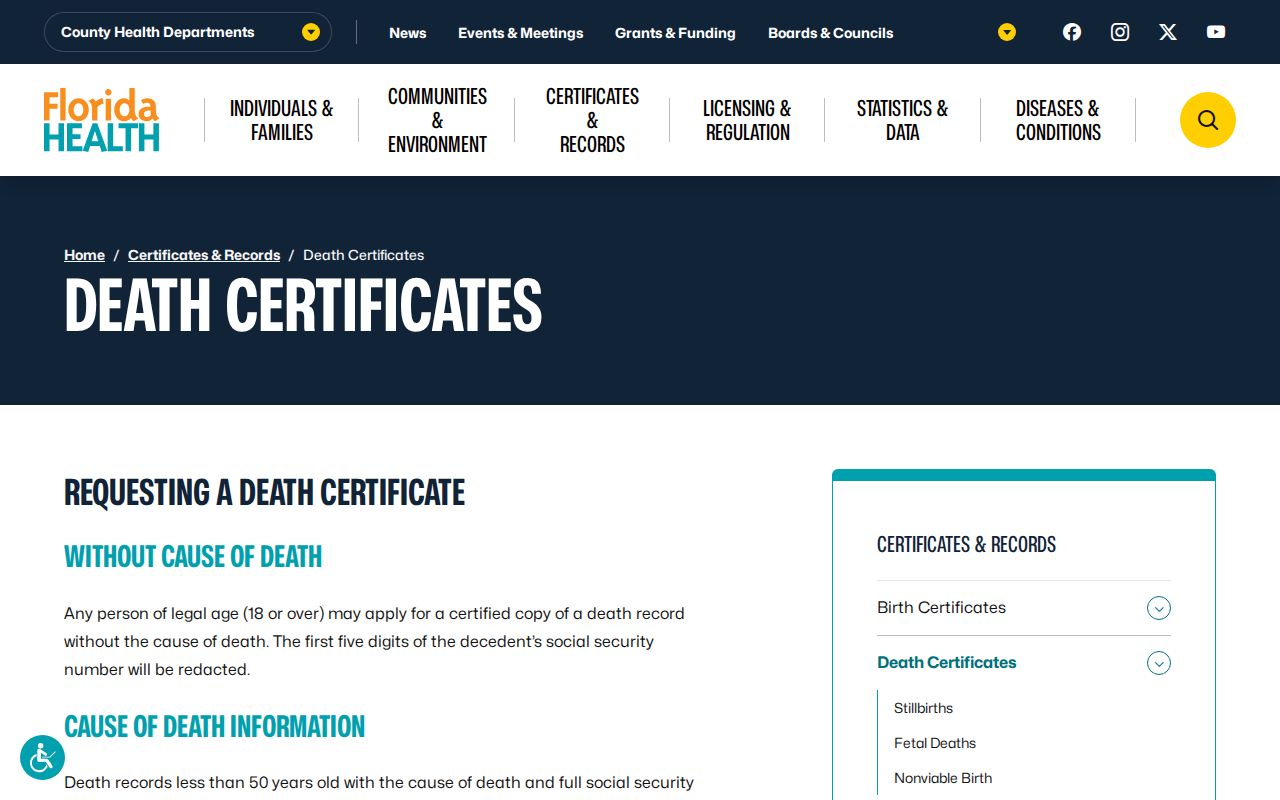
The state page helps distinguish a public death certificate from restricted cause-of-death details before an order is placed.
Marriage evidence can connect names across a deed or directory. Florida's statewide marriage abstracts begin June 6, 1927; earlier St. Johns County marriage records remain a Clerk matter.
Review Florida marriage-certificate coverage and ordering.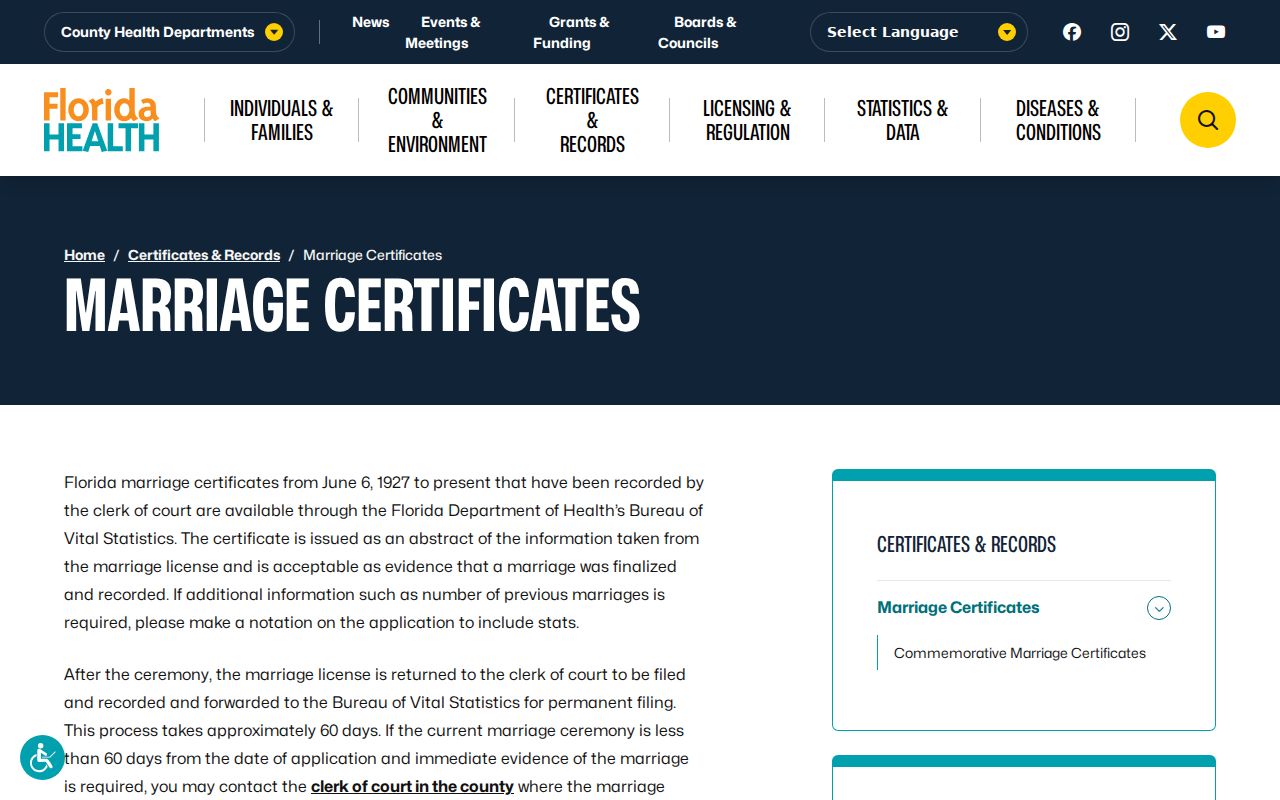
A state abstract reports selected event facts and should not be described as the underlying license application.
Use Previous Resident Records Lawfully
A recorded deed proves the transfer described in that instrument, not physical occupancy. A directory and census are dated observations with gaps. Protected addresses, recent moves, children, informal household ties, and source errors may be absent. Confirm important findings with the custodian and keep the source date attached to each name.
Lawful use. Research previous residents for house history, genealogy, estate work, or personal curiosity. Never use a record to track, harass, intimidate, or harm a living person.