
St. Johns County Lookup Sources
A useful resident lookup separates location leads from proof. The Property Appraiser ties an owner to a parcel and displays both site and tax-mailing addresses. VoteSJC verifies a registration record for an individual, while the Clerk identifies parties in recorded instruments and court matters. Florida agencies keep event certificates, corporate filings, and professional license records. None is a master list of everyone in a home. Renters, children, recent movers, people with protected addresses, and informal household members may not appear at all.
| Record | What It Confirms | Where to Search | Access |
|---|---|---|---|
| Property roll | Owner, parcel, site and mailing leads | St. Johns County Property Appraiser | Free search and downloads |
| Voter registration | Registration residence and status | VoteSJC | Individual verification; exemptions apply |
| Court records | Party role, case type and dates | Clerk Benchmark search | Public modern files online; older files by terminal or request |
| Vital records | Birth, death, marriage or dissolution event | Florida Vital Statistics and Clerk | Eligibility varies by record |
| Licenses and filings | Credential or business affiliation | DBPR and Sunbiz | Free public indexes |
| Probate | Estate roles and heirs named in open filings | St. Johns County Clerk | Online, terminal, or records request |
Choose the first search by the fact already known. An address points to the property roll. A case number belongs in the Clerk portal. A company name fits Sunbiz, and a trade or professional credential belongs in the state license system. Use a second source to test the match. That habit is the core of a sound St. Johns County resident lookup.
Search St. Johns County Court Names
The St. Johns County Clerk case search accepts a name in “Last, First” order. It also accepts a case or citation number as the main search. Date-opened and date-closed ranges, court type, party type, and a statute or charge can narrow a crowded result set. Party choices include plaintiff, defendant, judge, attorney, and alias. The portal covers county and circuit categories ranging from probate and wills on deposit to small claims, civil traffic, and criminal matters.
| Search field | How to use it | Required |
|---|---|---|
| Name | Enter “Last, First” and try known variants | Conditional |
| Case or citation number | Use instead of a name when known | Conditional |
| Opened or closed dates | Limit the filing period | No |
| Court and party types | Choose the role and kind of proceeding | No |
| Statute or charge | Add a focused legal-category filter | No |
A docket is a case activity list, not a judgment about a person. Juvenile, adoption, sealed, expunged, and other confidential matters remain outside ordinary access. The research did not verify a single start date or a stable public sample result, so do not assume the web index is complete for every year.
Florida publishes rules for electronic access to court records. The image below explains why online document access can differ by record and user role.
When the web search stops short, public terminals at the Clerk’s office may expose disclosable archival scans that are not available remotely.
Confirm St. Johns County Name Matches
Common names create the largest resident lookup risk. Match at least two independent facts before linking records. A middle initial, spouse, parcel legal description, business affiliation, or event date can separate two people with the same name. Do not use a tax mailing address as proof of occupancy. It may belong to an owner, agent, or post-office box. A voter record is a registration assertion at a point in time, not a count of every person at the address.
Dates deserve the same care. A former license, old annual report, prior deed, inactive voter registration, or closed case describes a past status. Read the record’s date and role, then confirm it with the office that keeps it. If the source is wrong, seek correction from that custodian rather than trying to erase a different public index.
Florida Records Extend Resident Lookup
County sources are only one layer. The Florida appellate ACIS portal searches appellate cases, parties, oral arguments, and available documents. It should not be confused with the Clerk’s local trial-court system. Federal matters normally route through the Middle District of Florida and PACER. Keep the court level clear when comparing results.
The appellate search shown below is useful after a local case moves to review. Its statewide scope does not prove that a party currently lives in St. Johns County.
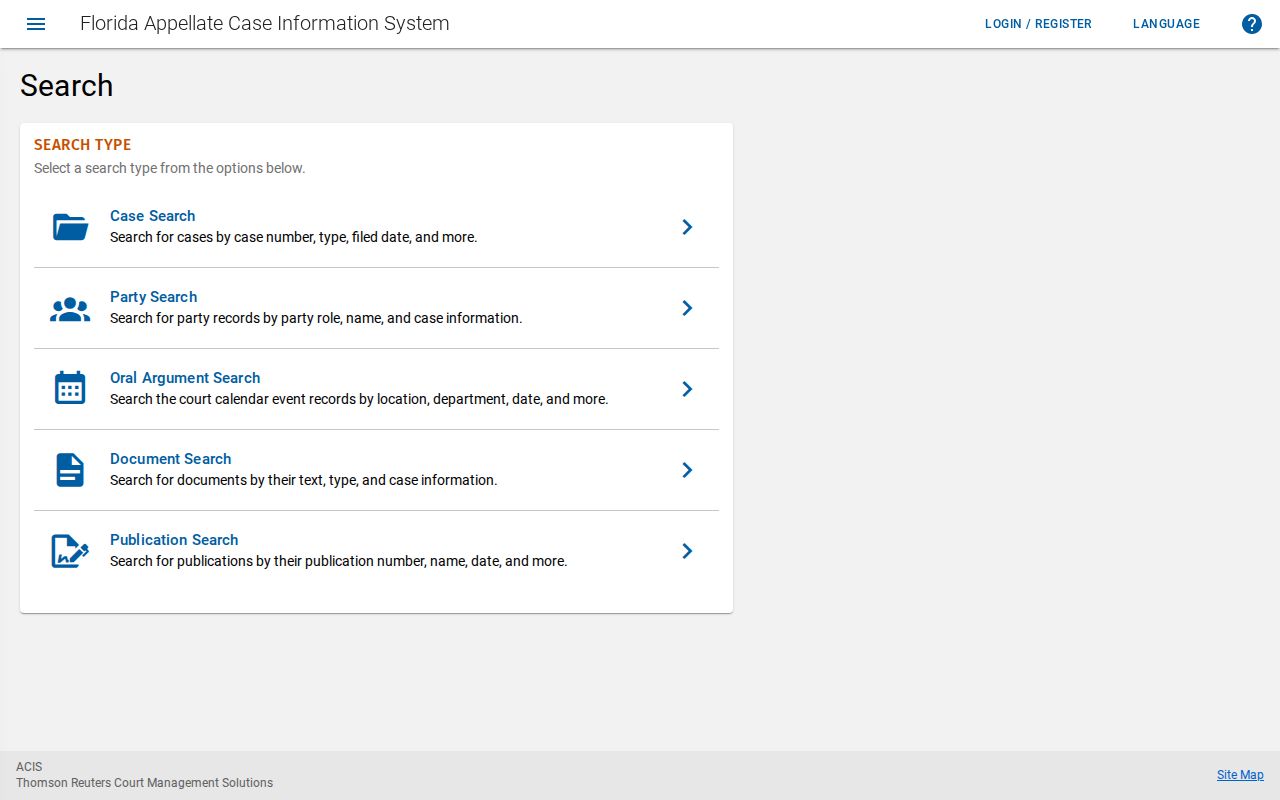
Record the case level, party role, filing date, and disposition before treating a result as identity evidence.
Verify St. Johns County Affiliations
The Florida Division of Corporations and Department of Business and Professional Regulation can confirm affiliations attached to a name. Sunbiz offers searches by entity, officer or registered agent, document number, ZIP, and street address. A filing can show principal and mailing addresses, agent details, officer names, annual-report history, and filing images. Those are business roles. A registered agent or principal address does not prove residence.
The DBPR license search accepts a name, license number, city or county, and license type. Search results can show a profession, address, status, and historic license when that option is selected.
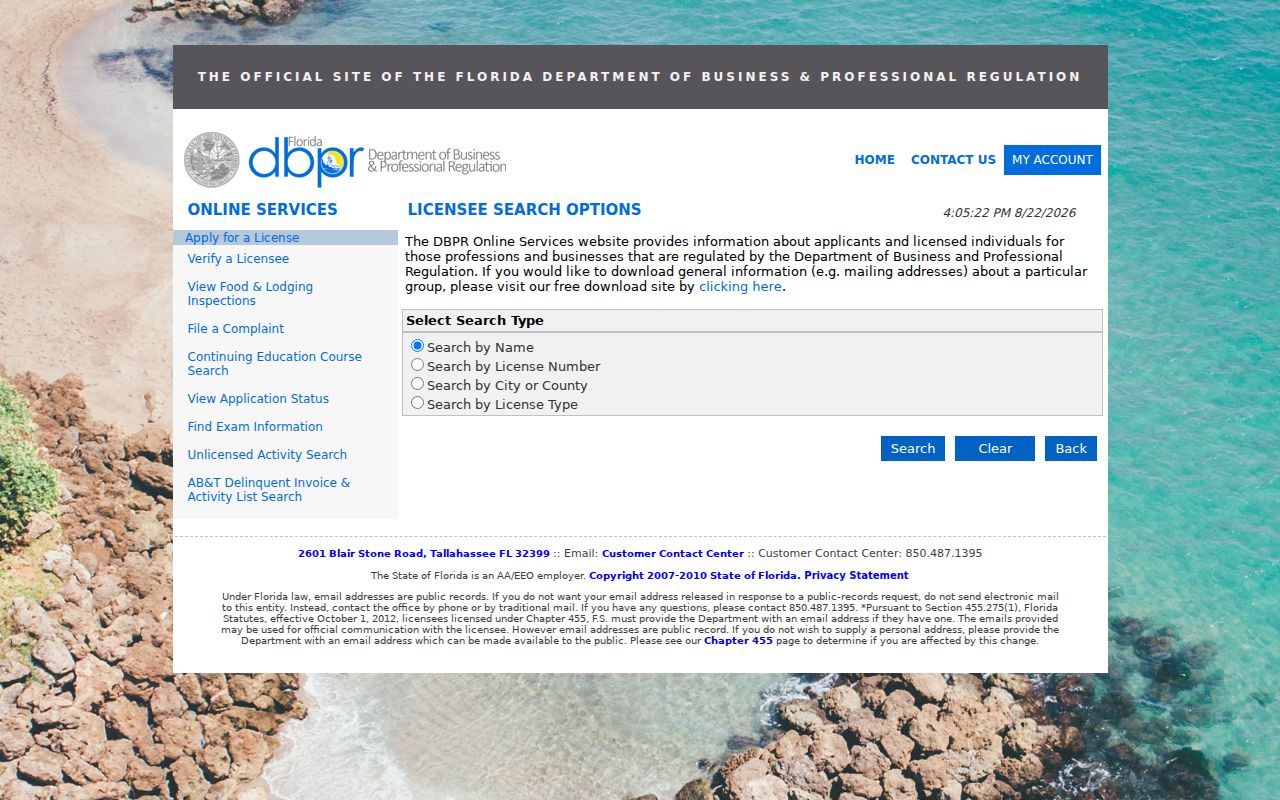
Historic status is helpful for tracking an older affiliation, but corroborate any listed address with a dated parcel, voter, court, or vital record.
St. Johns County Heir Searches
Probate and recorded interests can connect a deceased owner with representatives or heirs named in public filings. Start with the parcel and deed history, then search probate by the decedent’s name and likely year. Obituaries, yearbooks, and the St. Augustine Historical Society’s family files may add family or classmate context, but they are finding aids rather than certified proof.
Florida birth records under the confidential period require an eligible applicant or lawful authorization. Adoption-related searches belong in official confidential adoption or reunion channels, not in attempts to work around birth-record limits. For a former classmate, the county library catalog and historical directory collections are more fitting than a present-day address search. These personal uses show why a resident lookup must follow the rules of each record series.
Confirm St. Johns County Life Events
Florida Vital Statistics issues statewide certificates, while the St. Johns County Clerk supplies local marriage records and dissolution judgments. Birth certificates under 125 years are confidential. Death certificates without cause are generally public to adults, but cause-of-death details stay restricted for 50 years. Marriage and dissolution abstracts are public from June 6, 1927 forward; an older record must be sought from the county that issued or decided it.
A state abstract is not the underlying marriage application or divorce judgment. For a St. Johns marriage, search the Clerk’s Landmark index first and order an ordinary or certified copy when proof is needed. The Bureau accepts mail and walk-in requests, and contracted online ordering is also available. Eligibility, identification, fees, and processing depend on the certificate type.
Verify a St. Johns County Resident
Use a short, repeatable check instead of collecting every name hit. The goal is to anchor one person to a dated fact, test that match elsewhere, and obtain the underlying record when the index alone is not enough.
- Search the Property Appraiser by owner name, or verify an individual through VoteSJC. Note the date and whether the address is a site, mailing, or registration address.
- Run the Clerk party search in “Last, First” order. Add an alias, date range, court type, or party role to reduce false matches.
- Test the match against a second source, such as a recorded instrument, probate file, public vital abstract, business filing, or license record.
- Inspect the underlying image or case file. Order a certified copy only when an official authenticated record is needed.
- Docket
- The dated list of filings and events in a court case.
- Index vs image
- An index points to a record; an image shows the filed document itself.
- Certified copy
- A custodian-authenticated copy used when ordinary printouts are not enough.
If older material is missing online, call Clerk Records at 904-819-3632 or inspect public terminals at 4010 Lewis Speedway. A written request can include the name, date of birth if lawfully known, case type, year, delivery choice, and whether certification is needed.
Request St. Johns County Records
Florida Public Records Law, Article I section 24 of the Florida Constitution and Chapter 119, provides inspection and copying rights for existing nonexempt records. It does not require an office to answer a research question or create a new analysis. A narrow request works best: identify the record series, spelling variants, date range, case or parcel if known, and electronic delivery.
For court files, the Clerk accepts portal searches, counter inspection, mail, and records-request channels. The convenience form asks for a description, case number, date of birth, parties, copy or certification choice, and delivery method. Ask for a cost estimate before a broad search. For property data, the Property Appraiser also offers free CAMA and GIS downloads and a public-record contact, which can be more efficient than asking staff to compile names.
Reconnect Through Florida Property
Florida Treasure Hunt can provide a dated lead when money or property was reported under a person’s or business’s name. Searching is free. A match does not prove present residence, and a claimant must supply documentation before the state releases property.
Use the official Florida Treasure Hunt search shown below, then compare the reported name and address with a second record.
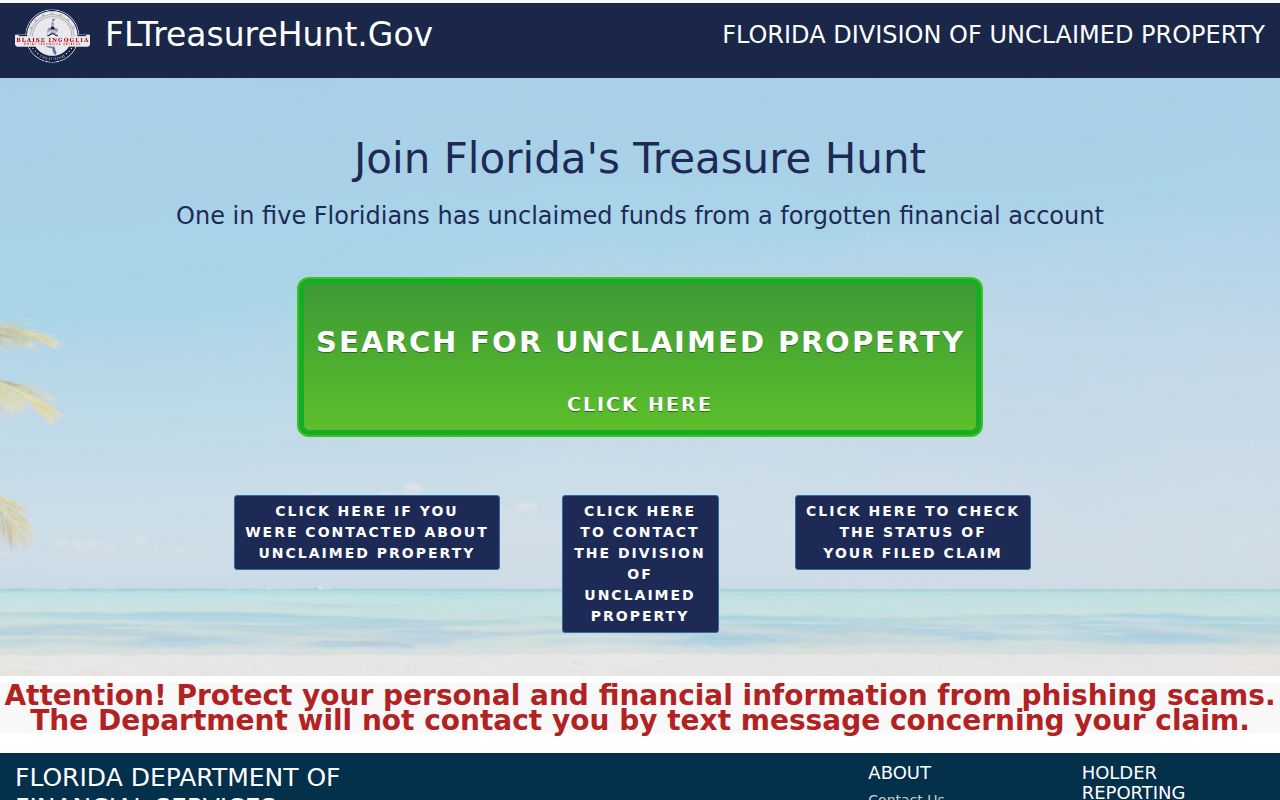
This can help an heir or relative find a possible asset without treating the reported address as a current location.
Resident Lookup Limits in Florida
Open records still contain firm boundaries. Florida’s Address Confidentiality Program supplies a substitute address and mail forwarding for qualifying victims. Verified exemptions can also shield home and family information for certain high-risk professionals. Social Security numbers, protected court data, confidential vital details, juvenile matters, and sealed or expunged cases do not become open because someone searches a name. An empty result may reflect protection, not absence.
The Florida Digital Bill of Rights creates rights against certain covered large commercial controllers, but it does not erase source records held by the Clerk, Property Appraiser, or elections office. A commercial removal request affects only that compilation. Government errors must be corrected with the agency that keeps the record.
Lawful use. Use a St. Johns County resident lookup only for lawful personal research. Florida law prohibits stalking, cyberstalking, threats, and harassment.