
How to Find St. Johns County Residents
A useful search begins by separating location clues from identity evidence. The St. Johns County Property Appraiser can connect an owner or site address to a parcel, while the Supervisor of Elections can verify an individual registration through its identifying-input lookup. The Clerk's Landmark index connects names with deeds, mortgages, liens, plats, probate documents, and other recorded instruments. For an older St. Augustine household, the public library, Historical Society Research Library, census schedules, and verified city directories are stronger starting points than a current parcel card.
No public roll captures every person at a dwelling. A deed identifies parties to a conveyance, not everyone occupying the home. The tax mailing address can differ from the site address. Voter records omit nonvoters and protected registrations, and a professional or business filing may show a work address. Treat each hit as a dated clue and seek a second independent anchor before concluding that two same-name entries describe one person.
- Search the Property Appraiser by owner, address, address range, parcel number, or legal information.
- Use VoteSJC to verify an individual registration, keeping protected fields and address exemptions in mind.
- Pivot from the parcel or legal description into Landmark to inspect deeds and other instruments.
- For past residents, consult the verified directories, census records, maps, and Society street files.
- When the web ends, request the named record series from its custodian under Chapter 119.
The Offices Behind St. Johns County Resident Records
Three constitutional offices carry much of the current trail. The Clerk records instruments and maintains county and circuit court files; the Property Appraiser maintains parcel ownership and mapping data; and the Supervisor of Elections maintains voter registrations. Their roles do not overlap cleanly. The Clerk does not decide current ownership from a tax roll, and the Property Appraiser does not certify title. For address-led work, the St. Johns County street directory explains the full parcel-to-deed sequence.
Clerk Recording Division
4010 Lewis Speedway
St. Augustine, FL 32084
904-819-3600
St. Johns County Property Appraiser
4030 Lewis Speedway, Suite 203
St. Augustine, FL 32084
904-827-5500
Supervisor of Elections
Countywide voter services
St. Johns County, FL
Official contact through VoteSJC
Start a St. Johns County Name Search with Two Anchors
A name alone is rarely enough. Begin with the spelling and one stable second fact: a parcel, an approximate year, a court type, an alternate surname, a business affiliation, or an event. In the Property Appraiser search, owner name can lead to a parcel ID, site address, mailing address, legal description, values, sales, and exemptions. In Landmark, the same name can be tested as a direct or reverse party and narrowed by book type, document category, and recording dates.
The St. Johns County resident lookup carries this one-person workflow through voter, court, vital, business, professional-license, and unclaimed-property sources. The purpose is not to pile up matches but to identify what each custodian actually attests.
Why the St. Johns Property Roll Comes First
The Property Appraiser search is the strongest first stop for a current owner or address question because it accepts owner name, location address, parcel number, and legal information. The address mode can accept a range, which is useful when the known clue is a street segment rather than one house. Free CAMA downloads extend the same work to larger sets, and supplemental CAMA adds building, land, sale, and traverse data.
The official Property Appraiser gateway is shown below, with its office identity and routes into parcel data.
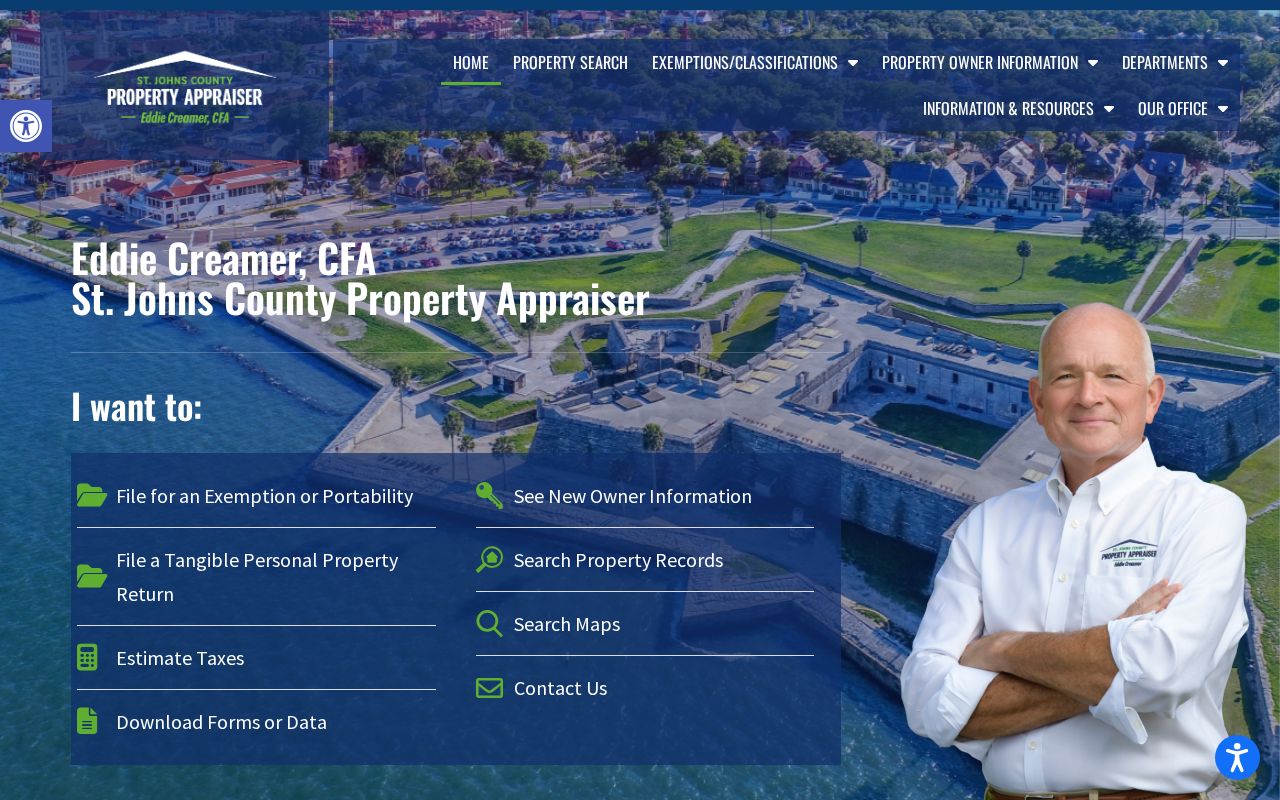
The image is a starting gateway, not a resident roster. Always distinguish the site address from the tax mailing address, and read an exemption as a tax indicator rather than proof of who occupies the property.
Move from a Parcel to St. Johns County Deeds
Once the parcel search supplies a parcel ID or legal description, move to the Clerk's Landmark Official Records Search. Its modes include name, document, case number, book/page, consideration, parcel ID, record-date range, Clerk File Number, and legal description. Name search can be changed among Contains, Direct Name, and Reverse Name logic and narrowed by document type. That matters when following a grantor into a later purchase or reversing a chain from the current grantee.
Search and remotely released images are free, but a portal image is not automatically certified. Ordinary copies, oversized pages, certification, and e-certification have separate charges. If an image or older series is unavailable, use the public terminals at 4010 Lewis Speedway, call Recording at 904-819-3600, email Recording@stjohnsclerk.com, or send a focused request. The portal's 1775 shortcut is only an interface boundary, not proof that every series is complete from that year.
Current St. Johns County Directory Sources
Modern directory evidence is distributed among specialized rolls. Each source includes only the people connected to its legal or administrative purpose. That limitation is useful: the custodian, date, and record type make an official result easier to evaluate and correct than a commercial compilation.
| Official source | People represented | Custodian | How to reach it |
|---|---|---|---|
| Parcel and tax roll | Recorded owners | Property Appraiser | Free search, map, downloads, counter, or records request |
| Voter registration | Registered voters | Supervisor of Elections | Individual lookup; lawful public extract with redactions |
| Official Records | Parties to recorded instruments | Clerk Recording Division | Free index/images where released; terminal, request, or paid copy |
| Court index | Named case parties | Clerk of Court | Modern portal; archival terminal or request |
| License and entity files | Licensees, agents, and officers | DBPR and Sunbiz | Free state searches; addresses may be professional |
Use the property roll for title, VoteSJC for registration, Landmark for recorded parties, and Benchmark for a local court role. A result can confirm that a named person appears in that record, on that date, but should not be stretched into a complete household claim.
What Florida Voter Records Reveal and Protect
The St. Johns County Supervisor of Elections maintains the authoritative individual voter record and handles corrections and protected registrations. Florida generally treats name, residence address, date of birth, party, phone, and email in voter information as public. Section 97.0585 protects Social Security, driver-license or state-ID numbers, the application source, and copied signatures. Preregistrants and people covered by address-confidentiality or occupational exemptions receive additional protection.
The statewide active/inactive extract is not an open web browser. It is requested in advance and delivered on physical media by mail or pickup, with protected fields removed. A status record documents registration at a point in time; voting history shows participation, never the ballot choice. Undeliverable mail and update cycles also mean an inactive record should not be treated as current proof of residence.
The VoteSJC service page provides the local verification route and the county office's official guidance.

Use that local channel for an individual record or correction; use the Florida Department of State extract process only when a lawful broader file is genuinely needed.
Modern and Archival St. Johns Court Searches
The local Benchmark portal covers St. Johns County Circuit and County Court matters and accepts name, case number, citation, opened or closed date ranges, court types, party roles, and statute or charge filters. Court types range from civil, probate, guardianship, small claims, and municipal ordinance to criminal and traffic categories. A docket identifies a legal proceeding and party role; allegations are not findings, and the final order or judgment controls the outcome.
The online/offline boundary is important. Publicly disclosable modern files, generally from the 1990s forward, are commonly available online. Archival court records from 1821 to about the 1990s may require the Clerk's terminals, PRR@stjohnsclerk.com, mail, or an in-person request at 4010 Lewis Speedway. A request can specify the person, date of birth if lawfully known, case type or year, delivery method, and whether certification is needed. Sealed, juvenile, adoption, protected family, victim, or mental-health information remains restricted under Florida court rules.
When Chapter 119 Is the St. Johns County Fallback
Florida's access baseline is Article I, section 24 of the Florida Constitution and Chapter 119, Florida Statutes. Sections 119.01 and 119.07 permit any person to inspect or copy nonexempt records without a general residency or purpose requirement. A custodian must respond promptly and in good faith, but Florida law sets no universal three-day or ten-day deadline. Time depends on locating, reviewing, and redacting the requested material.
Use the office that created or keeps the record. County Building records can be requested through publicrecordsbldg@sjcfl.us; Clerk records through the relevant portal, PRR@stjohnsclerk.com, mail, or hand delivery; Property Appraiser data through publicrecords@sjcpa.gov. Inspection is different from purchasing copies, and an agency should cite a specific exemption when it withholds part of an otherwise public record.
Florida's public-records guidance summarizes official request and fee principles for state-held material.
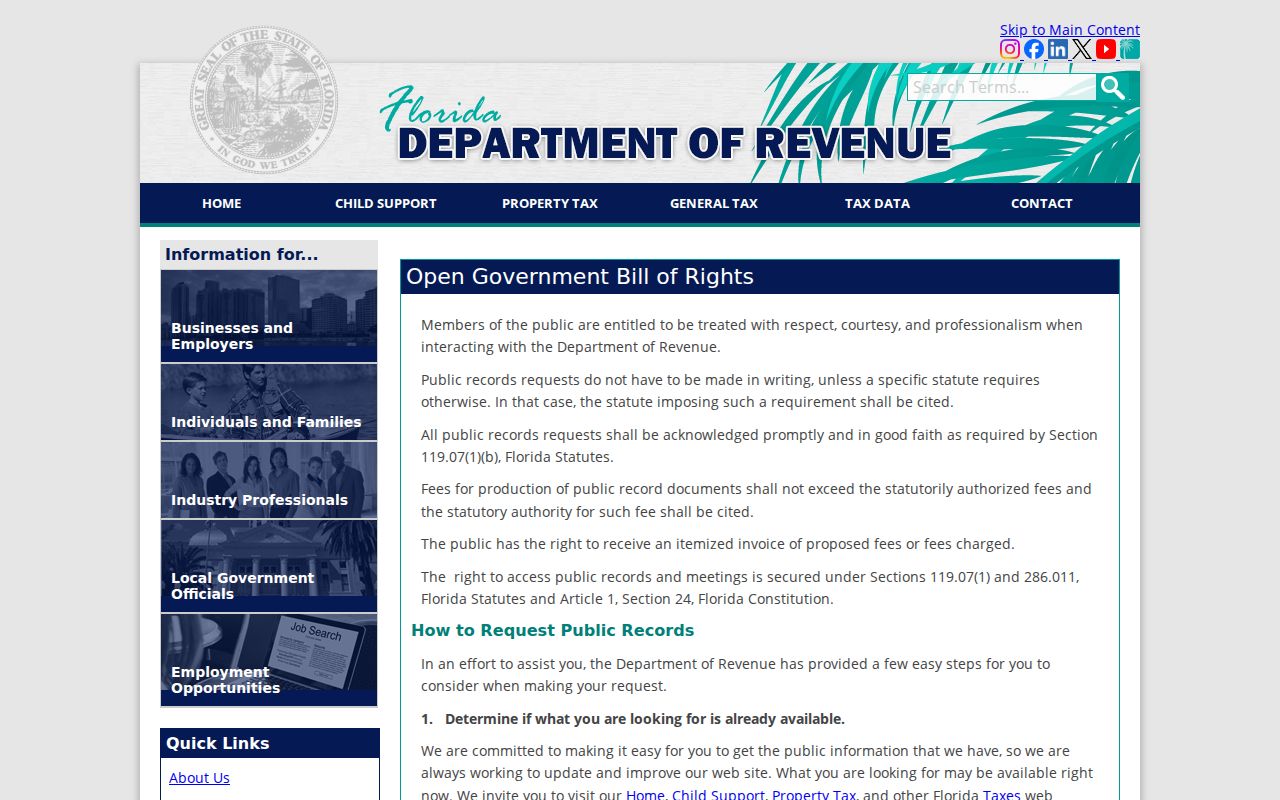
That guidance reinforces the difference between asking for an existing record and asking staff to research or analyze a person.
Vital Records Require the Right St. Johns Custodian
Birth, death, marriage, and dissolution records are not interchangeable. The Florida Bureau of Vital Statistics supplies statewide certifications by application, mail, walk-in service, and a contracted online channel. The Florida Department of Health in St. Johns County offers eligible local birth and death service. The Clerk supplies St. Johns marriage-license records and divorce judgments. State marriage and dissolution abstracts begin June 6, 1927; earlier records remain a local or archival question.
Birth records under 125 years are confidential under Chapter 382. A death certificate without cause is generally public to adults, while cause-of-death information is restricted for 50 years under section 382.025. A state marriage or dissolution abstract reports selected event facts; it is not the county license application or full court judgment. Certified evidence should come from the custodian that holds the exact record needed.
Florida's official birth-certificate page shows the state application route used for eligible requests.
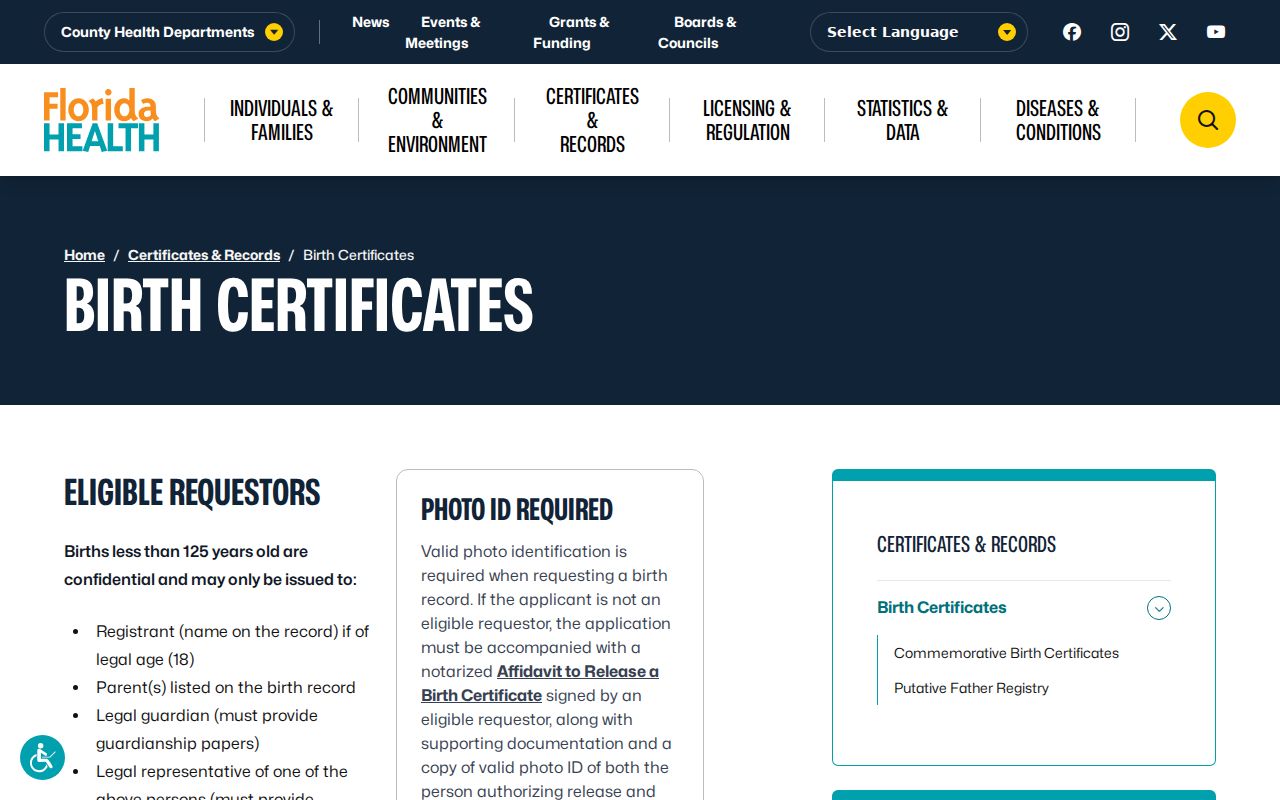
The state page helps identify the right application, while the county or Clerk remains the better source for records held locally.
St. Johns County Records Reach Spanish Land Grants
St. Augustine's role as county seat and its unusually long settlement history make the local trail deeper than a typical modern directory search. Property mapping documentation reaches into Spanish land-grant context, while Clerk and Historical Society court holdings extend to 1821. That depth does not mean every series is continuously indexed online. It means a modern parcel can sometimes be bridged into older legal descriptions, plats, street files, maps, and archival court material.
The safest bridge is geography: preserve the parcel ID and legal description, compare deeds, then use the Society's street-arranged files and Sanborn maps when street numbers or names do not align. The State Archives, Florida Memory, federal census schedules, and local church or family collections can supply another dated anchor. An archive finding aid or old map is evidence of context, not a certified substitute for the underlying deed or court file.
A 2025 Snapshot of St. Johns Recording Activity
Recent county totals show why a single search result needs a date and document type. In 2025 the Clerk reported 19,158 deeds, 13,189 mortgages, 2,854 marriage licenses, 28 plats, 81 PUD maps, and 39,975 court cases. The free Recording Activity Notification service had 11,700 enrollees. These figures describe active record systems, not a population count or directory membership.
Recording Activity Notification lets a person or business register name variants and an email address. A matching Official Record triggers an email; the alert does not block recording or prove fraud. Inspect the named instrument or CFN, then contact the appropriate office or law enforcement if something appears suspicious. Registration itself may be a public record, another reason to read the form before submitting.
Historical St. Johns County Resident Directories
Verified digital points include the 1880 Chapin & Co. directory and a 1904 history, guide, and directory for St. Augustine. The 1880 volume records compact clues such as occupation, employer, “house,” “boards,” and locations near cross streets. It can be paired with the 1880 federal census and 1885 Florida census, while nine St. Augustine Sanborn editions from 1884 through 1946 help stabilize the physical block. The 1890 federal census loss makes these local sources especially valuable.
The St. Augustine Historical Society Research Library at 6 Artillery Lane holds closed-stack maps, court and probate material, church records, family files, photographs, newspapers, and street-arranged evidence. Call 904-825-2333 and give staff surname variants, a street, and target years; offsite material may need two business days' notice. SJCPLS adds its catalog, in-library Ancestry, ArchiveGrid, and Gale Directory Library. Because neither institution publishes a complete year run online, ask specifically about city, telephone, reverse, and criss-cross directories rather than claiming an exhaustive shelf. The St. Johns County city directory guide explains those collections edition by edition.
The St. Johns County Public Library System is the countywide catalog and database gateway for the first shelf check.
The library image marks the online entry point; branch-only databases and uncataloged questions may still require a visit or staff reply.